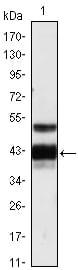
Code
BT-MCA4552
Host
Mouse
Isotype
Mouse IgG1
Size
100μL,50μL
Clonality
Monoclonal
Immunogen
Purified recombinant fragment of PROZ expressed in E. Coli.
Formulation
Ascitic fluid containing 0.03% sodium azide.
Storage
Store at 4°C short term. Aliquot and store at -20°C long term.
Background
PROZ protein Z, vitamin K-dependent plasma glycoprotein. It is 62 kDa large and 396 amino acids long. It has four domains: a gla-rich region, two EGF-like domains and a trypsin-like domain. It lacks the serine residue that would make it catalytically active as a serine protease. It is a member of the coagulation cascade, the group of blood proteins that leads to the formation of blood clots. It is vitamin K-dependent, and its functionality is therefore impaired in warfarin therapy. It is a glycoprotein. Although it is not enzymatically active, it is structurally related to several serine proteases of the coagulation cascade: factors VII, IX, X and protein C. The carboxyglutamate residues (which require vitamin K) bind protein Z to phospholipid surfaces. The main role of protein Z appears to be the degradation of factor Xa. This is done by protein Z-related protease inhibitor (ZPI), but the reaction is accelerated 1000-fold by the presence of protein Z. Oddly, ZPI also degrades factor XI, but this reaction does not require the presence of protein Z. In some studies, deficiency states have been associated with a propensity to thrombosis. Others, however, link it to bleeding tendency; there is no clear explanation for this, as it acts physiologically as an inhibitor, and deficiency would logically have led to a predisposition for thrombosis.
Uniprot accession
Molecular weight
45kDa
Gene ID
8858
Synonyms
protein Z;PZ
Research area
Neuroscience
Target protein
PROZ